
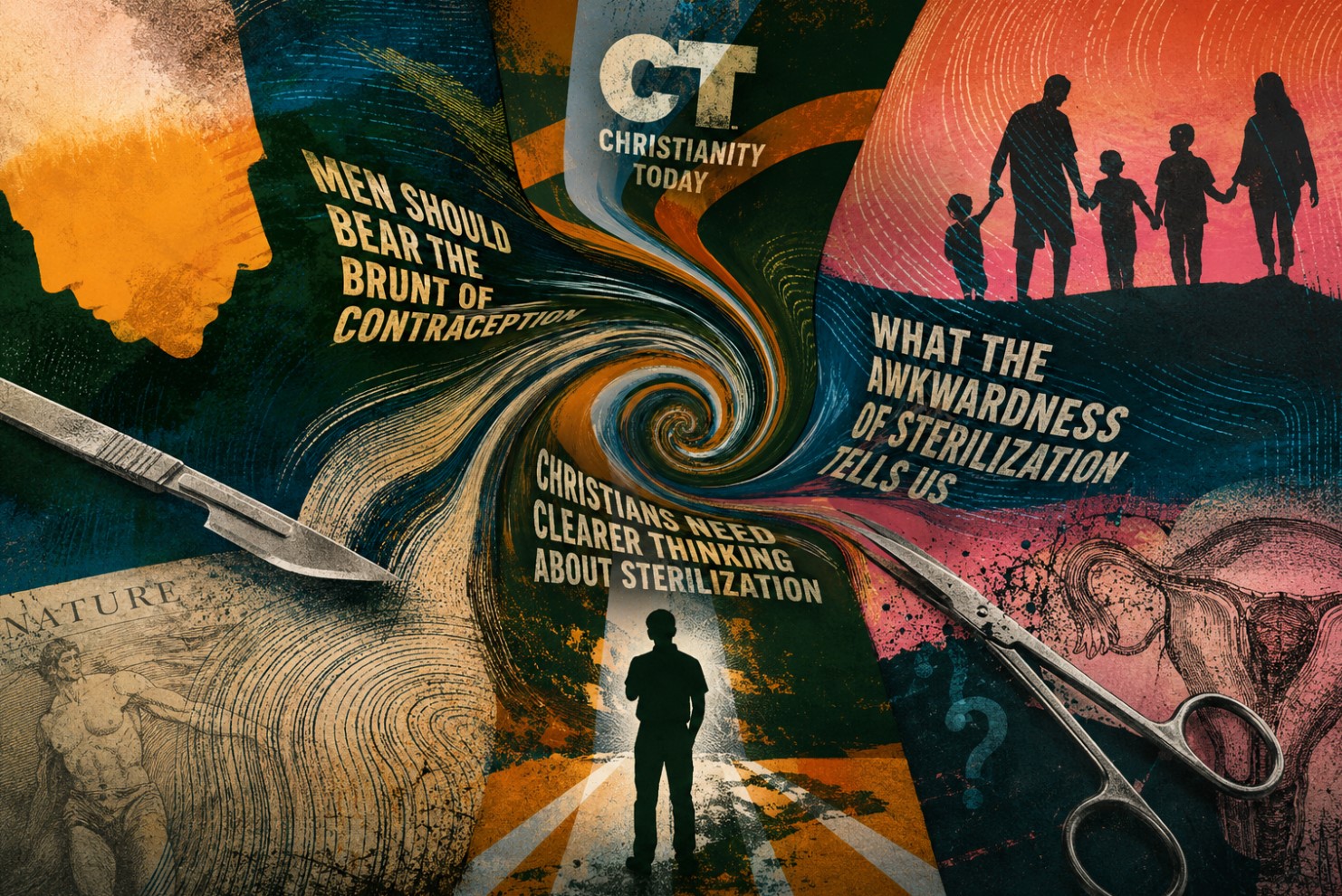
Christianity Today recently published a three-part article series, claiming Christians are finally debating sterilization (vasectomies and tubal ligation). The announcement that this debate was raging was news to most of us who consistently debate Christian issues online. The series pushes on contraception, sterilization, and Christian sexual ethics that many ordinary evangelicals will instinctively recognize as foreign to the Protestant theology they inherited. The series included:
- Men Should Bear the Brunt of Contraception by Justin Whitmel Earley
- What the Awkwardness of Sterilization Tells Us by Katelyn Walls Shelton
- Christians Need Clearer Thinking About Sterilization by Matthew Lee Anderson
At first glance, the articles appear to be a simple call for Christians to think more carefully about vasectomies and sterilization. But taken together, the series advances something much larger: a new evangelical anthropology rooted less in historic Protestant theology and more in a sacramentalized “theology of the body” framework borrowed heavily from Roman Catholic natural-law ethics.
“Catholicism” Today?
The concern is not merely that the authors oppose sterilization. Christians may legitimately wrestle with questions surrounding contraception, bodily stewardship, and the moral consequences of modern sexual culture. The deeper issue is the theological framework being used to answer those questions.
Throughout the series, the authors repeatedly:
- treat bodily “natural function” as morally authoritative in itself,
- frame fertility as a quasi-sacred category,
- elevate abstinence within marriage as spiritually preferable,
- portray continued marital intimacy apart from openness to procreation as morally suspect,
- and derive moral conclusions from bodily symbolism and instinctive revulsion rather than from clear biblical teaching.
The result is not an application of historic Protestant sexual ethics but a stealthy departure from them.
Matthew Lee Anderson, for example, makes perhaps the most revealing claim in the entire series:
“The only ‘need’ that Scripture knows of regarding sex is the need that undergirds conception.”
That statement alone should immediately raise serious theological concerns for any Protestant shaped by scripture. The Bible explicitly presents marital intimacy not merely as a mechanism for procreation, but also as mutual comfort, covenantal union, protection against temptation, affection, delight, and marital obligation.
The Apostle Paul writes:
The husband must fulfill his duty to his wife, and likewise also the wife to her husband. The wife does not have authority over her own body, but the husband does; and likewise also the husband does not have authority over his own body, but the wife does. Stop depriving one another, except by agreement for a time, so that you may devote yourselves to prayer, and come together again so that Satan will not tempt you because of your lack of self-control. 1 Corinthians 7:3-5 NASB
The passage does not frame sexual intimacy merely as a reproductive necessity. In fact, Paul warns married couples against prolonged abstinence except temporarily and by mutual consent. Yet throughout Christianity Today’s series, abstinence and renunciation are subtly elevated as spiritually superior states, while ongoing marital intimacy increasingly appears morally suspicious unless directly tethered to procreative openness.

This shift becomes even clearer when Anderson argues:
“When pregnancy might threaten a wife’s life, a husband honors her body and nature by remaining abstinent—rather than surgically contravening her body so that they can continue to have the pleasures of sex without its potentially deadly fruits.”
Notice the categories being introduced:
- “honoring nature,”
- “contravening the body,”
- suspicion toward “pleasures of sex,”
- and the implicit suggestion that indefinite abstinence within marriage may be morally preferable to prudential family planning.
These are not historically Protestant categories. They are far more at home within Roman Catholic natural-law reasoning and ascetic traditions.
Likewise, Katelyn Walls Shelton repeatedly grounds moral reasoning not in explicit biblical commands, but in bodily teleology and emotional instinct:
“Sterilization intentionally frustrates God’s design for the human body and for sex.”
And again:
“Repugnance is the emotional expression of deep wisdom.”
This appeal to instinctive revulsion as moral guidance is deeply unstable. Human beings instinctively recoil from many things that are not sinful, and Scripture repeatedly warns that fallen human intuition is not a sufficient moral authority. Christian ethics must ultimately be normed by divine revelation, not by what modern people experience as “weird,” “awkward,” or emotionally unsettling.
Even more revealing is the series’ recurring assumption that the body’s “natural” biological processes possess intrinsic moral authority that Christians violate at their peril. Earley writes:
“Natural family planning requires we adjust our lives to our bodies, not our bodies to our lives.”
But Christianity has never taught that “naturalness” itself is the measure of righteousness. Human beings constantly intervene in bodily processes through medicine, surgery, pain relief, orthodontics, and countless other technologies without assuming that redirecting biological function is inherently immoral. The question for Christians has never merely been whether something alters bodily function, but whether it violates God’s revealed moral order.
What makes the series especially significant is that it reflects broader ecumenical shifts already underway within evangelicalism, where Protestant categories such as Christian liberty, covenant theology, and the sufficiency of Scripture are increasingly displaced by concepts drawn from Roman Catholic natural law, sacramental body theology, and ascetic retrieval movements.
This matters because evangelicals absolutely do need a more serious and biblical response to the failures of modern sexual culture. Pornography, consumer sexuality, childlessness as lifestyle ideology, reproductive commodification, and the separation of sex from covenant responsibility are all genuine moral problems. But reacting against modern excesses by importing sacramentalized body mysticism and quasi-ascetic anthropology from fundamentally different theological traditions is an “answer” that betrays the corruption of biblical thought that has become Christianity Today’s trademark.
Marriage, Sexuality, and the Protestant Tradition
One of the most striking features of Christianity Today’s sterilization series is how foreign its moral atmosphere is to historic Protestant teaching on marriage and sexuality.
The Reformers certainly condemned sexual immorality, lust, adultery, fornication, prostitution, and sexual disorder. They also strongly affirmed children as blessings from God and rejected the selfish avoidance of family life. But unlike the ascetic traditions that preceded them, the Reformers did not treat marital intimacy itself as morally suspicious, spiritually inferior, or tolerable only because of procreation.
In fact, one of the major achievements of the Protestant Reformation was the recovery of marriage as a fully honorable Christian vocation rather than a concession to weakness beneath the supposedly “higher” spiritual state of celibacy.
This is why Matthew Lee Anderson’s claim is so startling:
“The only ‘need’ that Scripture knows of regarding sex is the need that undergirds conception.”
That statement is extraordinarily difficult to reconcile with Scripture itself.
Going back to 1 Corinthians 7:3-5, the Apostle Paul explicitly grounds marital intimacy not merely in procreation, but in mutual obligation, affection, and protection against temptation. Paul’s teaching here directly undermines Anderson’s reduction of marital sexuality to conception alone. Husbands and wives owe one another conjugal affection. Abstinence is permitted only temporarily, by mutual consent, and for spiritual devotion. Even then, Paul warns against prolonged deprivation because of human weakness and temptation.
The logic of the passage is unmistakable: marital intimacy is good, marital intimacy is expected, and unnecessary abstinence inside marriage is spiritually dangerous, not spiritually superior.
Yet throughout Christianity Today’s series, abstinence and renunciation are repeatedly elevated while ongoing marital intimacy is subtly reframed as morally suspect once procreation is intentionally limited.
Anderson writes:
“When pregnancy might threaten a wife’s life, a husband honors her body and nature by remaining abstinent—rather than surgically contravening her body so that they can continue to have the pleasures of sex without its potentially deadly fruits.”
Notice the assumptions built into the statement: continued marital intimacy is framed primarily in terms of “pleasures,” abstinence becomes the morally elevated path, and preserving sexual intimacy through family planning is implicitly associated with indulgence rather than covenantal affection.
But Scripture consistently speaks positively about sexual delight within marriage.
Solomon writes in Proverbs 5:18-19:
Let your fountain be blessed,
And rejoice in the wife of your youth.
As a loving hind and a graceful doe,
Let her breasts satisfy you at all times;
Be exhilarated always with her love.
Likewise, the entire Song of Songs celebrates longing, beauty, desire, delight, affection, and embodied union within covenant marriage. The book is not structured around procreation at all. It is a poetic celebration of covenantal intimacy itself.
Hebrews speaks of the entire scope of marriage in explicitly honorable terms:
Marriage is to be held in honor among all, and the marriage bed is to be undefiled; for fornicators and adulterers God will judge. Hebrews 13:4
The biblical vision of marriage is far richer than the narrow procreative framework of Christianity Today’s series. Historic Protestantism understood this clearly.
Martin Luther strongly rejected the medieval tendency to treat celibacy as spiritually superior to marriage. Luther repeatedly emphasized that marriage was not merely a biological arrangement for producing children, but a God-ordained context for companionship, affection, mutual service, and sexual union. In reacting against Rome’s elevation of celibacy, the Reformers deliberately restored dignity to ordinary married life.
Likewise, the Puritans often spoke far more positively about marital intimacy than many contemporary evangelicals might suspect. Puritan writers routinely celebrated marital affection, warned spouses not to withhold intimacy unnecessarily, condemned prolonged abstinence, and viewed sexual delight within marriage as both lawful and good.
This makes Christianity Today’s series especially ironic. The articles frequently sound less like the Reformers and more like the ascetic traditions the Reformers resisted. Throughout the series, abstinence is elevated, sexual renunciation becomes spiritually prestigious, pleasure is treated with suspicion, and fertility exposure becomes morally idealized.
The tragedy is that Christianity Today’s authors are reacting to real distortions in modern sexual culture, but in reacting against modern excesses, they risk reviving an older error: treating ordinary marital intimacy as spiritually dangerous unless carefully restrained by fertility, abstinence, or bodily “naturalness.” Scripture never speaks of faithful covenant marriage this way.
The Bible warns against lust, immorality, adultery, and sexual disorder. But it nowhere teaches that married couples should ordinarily view ongoing sexual intimacy with suspicion once procreation is intentionally limited. Nor does Scripture portray indefinite abstinence within marriage as a morally superior state. The Protestant tradition understood this distinction well. Christianity Today’s novel and ecumenical sexual ethic does not.
The Body as Revelation
Perhaps the most significant shift in Christianity Today’s sterilization series is not its conclusions about vasectomies themselves, but the method by which those conclusions are reached. Again and again, the authors appeal not primarily to explicit biblical commands, but to the supposed moral authority of bodily structure, biological “naturalness,” instinctive revulsion, and the “intrinsic ends” of human sexuality. The body itself increasingly becomes a kind of moral revelation.
Katelyn Walls Shelton writes:
“Sterilization intentionally frustrates God’s design for the human body and for sex.”
Matthew Lee Anderson similarly argues:
“The body with its organic functioning has no intrinsic authority to which we are responsible. It is instead subject to our modification, manipulation, or what has classically been called ‘mutilation.’”
And Justin Whitmel Earley writes:
“Natural family planning requires we adjust our lives to our bodies, not our bodies to our lives.”
These statements reveal a major theological assumption operating beneath the entire series: bodily processes themselves possess morally binding authority because their “natural ends” disclose God’s design. This is classic natural-law reasoning.
Historically, Roman Catholic theology—especially Thomistic theology—has often argued that the body’s natural functions reveal moral purposes that human beings are obligated to honor. Reproductive organs have reproductive “ends.” Sexual acts possess built-in teleological meaning. To intentionally sever pleasure from procreation is therefore viewed as violating the body’s created purpose.
That framework explains why the Christianity Today series repeatedly speaks in terms of:
- “organic functioning,”
- “intrinsic authority,”
- “natural rhythms,”
- “fitting ends,”
- “honoring nature,”
- and “contravening the body.”
But while these concepts may sound ancient or profound, Protestants have historically approached such questions very differently. The Protestant Reformation did not reject natural revelation altogether. Scripture itself teaches that creation reveals God’s power and divine nature:
For since the creation of the world His invisible attributes, His eternal power and divine nature, have been clearly seen, being understood through what has been made, so that they are without excuse. Romans 1:20
Yet Protestants also insisted that human reason, instinct, and perception are deeply corrupted by the Fall. Nature is not a second Bible. Human beings do not arrive at moral certainty merely by examining biological processes or contemplating bodily structures.
This is why Scripture—not instinct, “ick,” or teleology—must remain the final authority for Christian ethics.
Shelton’s appeal to “repugnance” is especially revealing:
“Repugnance is the emotional expression of deep wisdom.”
She even suggests that feelings of disgust toward sterilization may themselves function as moral guidance. This is mystical, gnostic reasoning, not biblical. Scripture repeatedly warns against trusting fallen human intuition as an independent ethical authority. Human beings instinctively recoil from many things God does not condemn, while simultaneously celebrating many things God explicitly forbids.
Isaiah writes:
For My thoughts are not your thoughts,
Nor are your ways My ways,” declares the Lord.
For as the heavens are higher than the earth,
So are My ways higher than your ways
And My thoughts than your thoughts. Isaiah 55:8-9
Likewise, in Acts 10, Peter instinctively recoils from eating what he considers “unclean,” only to be corrected by divine revelation:
A voice came to him, “Get up, Peter, kill and eat!” But Peter said, “By no means, Lord, for I have never eaten anything unholy and unclean.” Again a voice came to him a second time, “What God has cleansed, no longer consider unholy.” Acts 10:13-15
Human moral instinct is not infallible. Conscience must be governed by Scripture, not elevated above it. Yet the series continually derives moral law from bodily symbolism itself. The body’s structure increasingly becomes a theological text requiring obedience. This creates profound problems.
Human beings constantly intervene in “natural” bodily processes:
- antibiotics interrupt infections,
- insulin regulates bodily failure,
- braces alter skeletal development,
- eyeglasses compensate for impaired vision,
- surgery removes healthy tissue to prevent disease,
- and pain medication suppresses natural pain responses.
Human civilization itself is fundamentally “unnatural” in this sense. Christianity has never taught that redirecting bodily processes is inherently immoral simply because it modifies nature, particularly as scripture makes it clear that God clearly places mankind above nature and commands us to subdue it (Genesis 1:26-28).
The real question is whether an action violates God’s revealed moral order.
Yet throughout Christianity Today’s series, “naturalness” itself increasingly functions as a moral category. The body’s biological functions become quasi-sacred realities whose interruption carries spiritual significance independent of explicit biblical prohibition. This is a major departure from historic Protestant moral reasoning, and subjecting man to whatever is “natural” is mystical paganism, not biblical Christianity.
The Reformers consistently subordinated nature to revelation. They did not deny that creation reflected God’s wisdom, but they resisted the medieval tendency to derive elaborate moral systems from speculative teleology detached from clear biblical teaching. The Christianity Today series repeatedly moves in the opposite direction.
Even more concerning is the subtle sacramentalization of embodiment running beneath the articles. Fertility is not merely treated as a blessing from God—which Scripture certainly affirms—but as a kind of sacred bodily integrity that must remain perpetually open in order for sexuality itself to retain moral legitimacy.
The series often sounds less like biblical theology and more like a Protestantized version of John Paul II’s Theology of the Body. In that framework, the body itself becomes morally revelatory, biological structure communicates divine meaning, sexual complementarity takes on quasi-sacramental significance, and fertility functions almost as a theological symbol embedded into creation.
The danger is not merely theological confusion. It is that the body slowly begins to displace Scripture as the primary source of moral reasoning. Instead of asking, “What has God explicitly revealed about marriage, sexuality, and holiness?” the discussion becomes, “What do bodily processes symbolize, imply, or naturally point toward?” This is not Christianity. It is Roman Catholic mysticism.
Scripture warns repeatedly against sexual immorality. It celebrates children as blessings. It condemns selfishness, lust, adultery, fornication, and the abuse of the body. But Scripture nowhere teaches that biological “naturalness” itself constitutes a binding moral law governing every marital decision regarding fertility. Christianity Today’s series, therefore, represents more than a disagreement about sterilization. It reflects a deeper theological migration away from Protestant biblical ethics and toward a sacramentalized anthropology in which the body itself increasingly functions as moral revelation, human beings are elevated beyond our ontological status, and God is reduced to dependence on bodily functions for his revelation.
The Return of Protestant Asceticism
One of the most backward features of Christianity Today’s sterilization series is not simply its suspicion toward contraception, but its repeated elevation of abstinence, renunciation, and sexual restraint within marriage as spiritually preferable states. Throughout the series, ordinary marital intimacy is subtly reframed as morally dangerous unless carefully tethered to fertility, self-denial, or prolonged restraint.
Matthew Lee Anderson writes:
“Chastity is the freedom that comes from understanding and honoring the body’s intrinsic sexual powers by delighting in their use when the time permits and by cheerfully refraining when the season does not—even if that season is a permanent one for married couples.”
That sentence represents a remarkable shift away from historic Protestant instincts regarding marriage.
Notice what is being normalized:
- permanent abstinence inside marriage,
- sexual renunciation as spiritually elevated,
- and the suggestion that ongoing marital intimacy may become morally inappropriate once fertility is intentionally limited.
Likewise, Anderson argues:
“The only ‘need’ that Scripture knows of regarding sex is the need that undergirds conception.”
This is not merely a claim about vasectomies. It fundamentally reframes the purpose of marital intimacy itself. Historically, Protestants rejected precisely this sort of reductionism. The Protestant Reformers strongly opposed the medieval tendency to elevate celibacy and ascetic renunciation above ordinary married life. Rome had long treated virginity, celibacy, and sexual abstinence as spiritually superior states, while marriage was often regarded as a concession to weakness and desire.
The Reformation deliberately attacked that hierarchy. Luther rejected monastic asceticism not because he rejected self-control, but because he believed Scripture honored marriage as a full and holy Christian vocation. Marriage was not spiritually inferior to celibacy. Sexual intimacy within marriage was not morally suspect. Ordinary embodied life was not a lower spiritual state to be transcended through renunciation. Likewise, Protestant theology has historically sharply distinguished between biblical self-control and ascetic suspicion toward embodied pleasure.
Scripture certainly commands chastity, holiness, and self-control. Christians must not be enslaved to lust or governed by sinful passions:
For this is the will of God, your sanctification; that is, that you abstain from sexual immorality; that each of you know how to possess his own vessel in sanctification and honor, not in lustful passion, like the Gentiles who do not know God; 1 Thessalonians 4:3-5
But Scripture nowhere teaches that marital intimacy itself becomes spiritually dangerous once procreation is no longer desired or medically prudent. To repeat, 1 Corinthians 7:5 sees Paul warn against unnecessary deprivation within marriage precisely because sexuality inside marriage is not inherently corrupt.
Christianity Today’s series, by contrast, repeatedly frames continued marital intimacy after sterilization in terms of gratification, indulgence, domination of the body, and preserving “pleasure without consequences.”
Anderson writes:
“Those who dominate their bodies attempt to have the pleasure without its fitting ends.”
Elsewhere, he warns against:
“fight[ing] to protect the sexual gratification and pleasure we think is ‘necessary’ within our own marriages.”
Again, notice the framing. Continued marital intimacy increasingly appears morally compromised once conception is intentionally limited. The couple becomes suspect not because they are committing sexual immorality, but because they continue enjoying embodied intimacy while attempting to avoid pregnancy. This is precisely where the series begins sounding less Protestant and more ascetic.
Historically, the Reformers resisted the idea that spiritual maturity required detachment from ordinary marital affection. Many Puritan writers actually spoke quite warmly and positively about marital delight, companionship, and sexual affection within covenant marriage. Modern readers are often surprised to discover how strongly the Puritans condemned unnecessary abstinence within marriage. They understood prolonged deprivation not as a pathway to superior spirituality, but as a danger to marital unity and holiness.
The Christianity Today series quietly reverses that instinct. Abstinence becomes morally elevated. Renunciation becomes spiritually prestigious. Fertility exposure becomes ethically idealized. Ordinary marital sexuality becomes morally anxious.
This is especially evident in Anderson’s extraordinary suggestion that husbands may best honor their wives through permanent abstinence rather than through prudential family planning that preserves marital intimacy while avoiding dangerous pregnancy.
Why This Harmonizes So Easily with “Side B” Theology
To be clear, Christianity Today’s sterilization series is not explicitly about homosexuality or Side B theology. None of the authors argues for gay identity frameworks, celibate partnerships, or the broader Side B movement directly. Yet the theological overlap must not be missed. The same anthropological assumptions driving Christianity Today’s new sexual ethic also make modern Side B theology far more emotionally and philosophically plausible within evangelicalism.
Historically, evangelical Protestantism generally treated lifelong sexual renunciation as exceptional, difficult, and vocationally limited. Marriage was understood as the ordinary and normative context for sexual intimacy, affection, companionship, covenantal union, and protection against temptation.
Celibacy existed, but it was not elevated as a superior spiritual state, nor was permanent sexual non-fulfillment treated as the ordinary path of sanctification for large categories of Christians. That framework has shifted dramatically in recent years.
Increasingly, elite evangelical discourse frames holiness not primarily in terms of transformed desires and rightly ordered covenantal fulfillment, but in terms of perpetual restraint, management, and renunciation. Sexual desire itself becomes something to be continually denied, redirected, or permanently unfulfilled.
This is precisely where the Christianity Today series fits.
Matthew Lee Anderson writes:
“Chastity is the freedom that comes from understanding and honoring the body’s intrinsic sexual powers by delighting in their use when the time permits and by cheerfully refraining when the season does not—even if that season is a permanent one for married couples.”
That statement normalizes permanent abstinence not merely as tragic necessity, but as spiritually meaningful obedience. Likewise, Anderson repeatedly minimizes the covenantal significance of marital intimacy itself, reducing sexual “need” almost entirely to conception.
The implications extend far beyond vasectomies.
Once lifelong or permanent sexual renunciation becomes morally normalized even inside marriage, the conceptual distance to Side B theology shrinks dramatically. Biblical teaching on desire, sin, and properly exercised affection is replaced with the ideas that:
- all Christians are called to costly sexual restraint,
- holiness consists in sanctified non-fulfillment,
- desire itself need not be transformed or redirected toward lawful covenantal expression,
- and obedience may simply mean perpetual abstinence regardless of one’s relational state.
This creates a striking moral symmetry between Side B’s “celibate gay identity” framework and Christianity Today’s emerging ethic of marital renunciation. Both define Christian maturity through restraint, denial, non-fulfillment, management of desire, and ascetic discipline.
Yet scripture frames sanctification and obedient Christian living as sinful desires being mortified, lawful desires being rightly ordered, marriage as a legitimate and expected context for covenantal fulfillment, and ordinary embodied life not treated as spiritually suspicious. The Christianity Today series subtly shifts the center of gravity, with sexual holiness increasingly becoming not rightly ordered covenantal intimacy, but restraint, speaking of marital intimacy in terms of “gratification,” “pleasure,” “dominating the body,” and “having pleasure without its fitting ends.”
The implication is clear: continued marital intimacy after intentionally limiting fertility begins to resemble indulgence rather than covenantal faithfulness. This harmonizes naturally with Side B discourse, which similarly emphasizes costly obedience through lifelong restraint, sanctification through denied desire, and the spiritual beauty of permanent non-fulfillment.
This becomes especially important when paired with the series’s sacramentalized view of the body.
Once sexuality is framed primarily through bodily teleology, intrinsic “ends,” chastity-centered anthropology, and ascetic virtue, then sexual restraint itself increasingly becomes spiritually central. Marriage no longer functions primarily as the ordinary covenantal context for lawful intimacy. Instead, marriage itself becomes another arena for renunciation, discipline, and the suppression of embodied desire.
That is why these articles feel so foreign to many ordinary evangelicals. The issue is not simply contraception. It is a fundamentally different vision of sanctification, embodiment, and the Christian life itself.
The danger is that once holiness becomes primarily identified with restraint rather than rightly ordered covenantal fulfillment, evangelicalism loses the ability to distinguish between biblical chastity and quasi-ascetic suspicion toward embodied intimacy itself. The result is a sexual ethic that unintentionally reinforces many of the same assumptions already driving Side B anthropology throughout elite evangelicalism.
Ecumenical Drift and the Loss of Protestant Categories
At its core, Christianity Today’s sterilization series reveals something larger than a disagreement about vasectomies or contraception. It reflects a broader theological drift within elite evangelicalism away from distinctively Protestant categories and toward an ecumenical synthesis shaped heavily by Roman Catholic natural law, sacramental anthropology, and ascetic retrieval theology.
The concerns driving this shift are often legitimate. Modern evangelicalism has frequently been shallow, therapeutic, consumeristic, and morally thin. Christians are right to seek a thicker and more serious sexual ethic than the sexual consumerism of the modern age.
But Christianity Today’s answer increasingly treats the body itself as a theological text, elevating “naturalness,” bodily teleology, and ascetic renunciation beyond biblical warrant while softening historic Protestant commitments to Christian liberty, covenantal intimacy, and the sufficiency of Scripture.
Historic Protestantism did not treat faithful marital intimacy as spiritually suspect, nor did it derive moral law from bodily symbolism detached from clear biblical teaching. In reacting against the excesses of the sexual revolution, Christianity Today risks reviving precisely the sacramental and ascetic assumptions the Reformers intentionally corrected.
Evangelicals absolutely need a stronger theology of marriage, sexuality, and holiness. But importing sacramentalized body theology and ascetic anthropology from fundamentally different theological traditions is not Protestant renewal.
It is theological drift disguised as retrieval.